Monday, September 24, 2007

Cutting corners is cutting corners, No matter the intent

On Saturday I had the "privilege" of viewing a "reimagining" of the Magic Flute at the Butler Opera Center at The University of Texas at Austin. In the interest of full disclosure - I only viewed the first act. This isn't a review per se, rather a commentary on lessons learned, but it's better to be safe than screamed at.

The reimagining portion of this particular program was the incorporation of projections as the scenery. Projected scenery isn't particularly innovative, but The University of Texas at Austin affiliated program that developed this piece has recently invested in the Catalyst software and servers, and a high end performance projector, and have a program partnership with High End Systems so they have a vested interest in making the technology work and in getting their kids interested and proficient.

I am very interested in technology in performance. In all facets of my life I am interested in making one capital expenditure rather than perpetual recurring expenses. If I can use technology (even pricey technology) to offset per show aesthetics costs without any sort of compromise in show quality then I'm going to pursue it.

Aye, there's the rub.

Poorly done digital projections make the show look cheap. If you can't do the projections well, you are better off doing a rehearsal furniture set than the projections. No one is giving you special credit for having a laptop, and no one is interested in spending $10-50 to watch a PowerPoint show.

Unfortunately for Mozart and the audience, the Magic Flute ended up looking like a fancy PowerPoint show crossed with a very large game of Doom. I wanted very badly for it to be good. I know the artistic director of the piece, one of the creators of the animations, and the lighting designer; and as I said above I want this technology to be useful. That was not the case.

In the opening scene the Three Spirits kill the threatening serpent. They appeared via live feed on the screen behind an unconscious Tamino and a cowering Papageno. On screen were three layers. One layer was the live feed with a black background and the three slightly washed out Spirits (in Victorian whore makeup). In front of them a second layer of Barren Rocky Desert framing them like a mall photo booth digital frame. In the first layer was a  big ol' serpent. The digital graphics looked like remedial Photoshop work. The scene's in Sarastro's Castle were poorly scaled columns that looked like skinned polygons out of Doom.

Part of the problem is that you can't assume that eliminating meat world scenery from the production eliminates one of the artists, you simply replace the need for a scenic designer and carpenters with a need for a scenic designer and graphic artists  and computer techs. If you try to get by with amateurs in any aspect of your design it is going to look amateurish... projecting it on a 30' - 40' screen isn't going to help hide that at all.

The projections aren't new to your audience, and they have expectations. They expect true blacks. They expect verisimilitude. They expect, well, they expect film quality. The technology simply doesn't support that yet. They expect perfect audio and video synch. And that didn't happen on Saturday either, the Spirits were lagged audio to video by almost a full second. The performance was never simply about the performance.

In the end we all have to remember:

  1. Technology is simply another tool, it's not some sort of savior for your piece.
  2. You don't streamline the tech process by adding technology, you simply change it.
  3. You are doing live performance, not film, no matter how hard you try to disguise it.
  4. Be honest in your evaluation of how well the technology is suiting your production.
  5. Technology does not obviate the need to have Unity, or at the very least a consistent style.

And the technical aspects of your show, from black box to spectacle should never EVER upstage the production as a whole. 


As a producer who is shepherding a piece that will rely heavily on projections for this year's Frontera Fest, I think the above 6 lines are good rules to live by, along with remembering to prefer abstraction over verisimilitude...the projectors are another light source with a bit more specificity.

So what about you?

What is your experience with incorporating new technology into your productions?

What are your rules for using technology in the future?

What have you seen that's blown your mind?

What have you seen that has scared you off from ever using anything stronger than 60W bulbs in a coffee can?

Friday, September 21, 2007

I'm so vain, I know this post is about me (Sort of)

Yesterday the Austin Circle of Theatres announced their nominations for the 2006-7 B. Iden Payne Awards.

Intermission, my show from August was nominated for two awards.
In the  Music Theatre category.


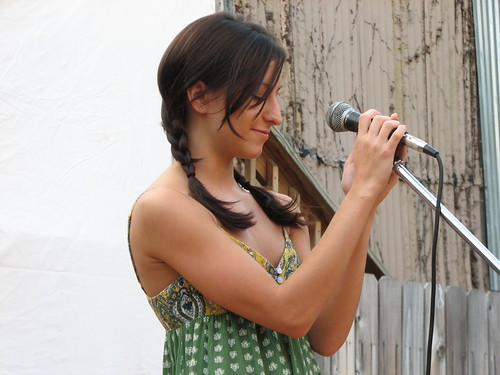
April Perez was nominated as Outstanding Lead Actress in Music Theatre for her portrayal of Miranda Swain. I've included a song from the show.

(Note to New Yorkers: April is in the City. Cast her. True triple threat.)

IMG_5298

Hang on Tight (Right Click Save As)


And Adam Hilton and Boone Graham are nominated for Outstanding Original Score. A demo version of 'Make it Ours' with Adam on vocals rather than April follows the picture (I have NO pictures of the reclusive Boone).

IMG_5281

Make it Ours (Right Click Save As)

 [Buy The Album!]

I am well pleased. The nominators assiduously avoided the portions of the show that I was most involved with, but as previously discussed I know where the trainwreckiness of that lies, and as my partner pointed out, there's no part of this show that I wasn't involved with. And most of the the backstory for Miranda is taken from a show I'd been hoping to do with my partner and Bora Yoon. So despite not being specifically honored, I'm taking it anyway. And I am proud beyond your mortal reckoning of the work April, Adam, and Boone did on this show.

So maybe Will and I will live to fight another day.


 I would also like to congratulate some friends who also got nominated:

illy herrin (ex- Aram Chaos) nominated for as Outstanding Lead Actress for Puck

Roz Mandola (ex-Elektra) as part of the cast of the Best Music Theatre nominated The Assumption

Autumn Casey (UT) for her lighting design for Marat/Sade

Ron Weisberg (ex-Elektra) as part of the Outstanding Ensemble for Wireless-less

Monday, August 27, 2007

The Gap in the Gap

On another note, I'd be interested in reading your "What's Wrong With Theater" post. If there's something that we're all whining about but not changing, I'd definitely want to know what that is.


And I'll admit some hostility toward your "War on the audience" concept, even though you haven't articulated it yet - hostility connected to baggage. I've just been through a binge of seeing theater because of the Fringe Fest here in NYC. I saw a lot of different styles and genres of shows, rendered with different degrees of skill, but all presented with joy of performance and a desire to connect. I couldn't detect a shred of hostility toward the audience.


Maybe that's not what you mean by the term. I'm just saying that as a fairly regular theatergoer, if there really is a rampant breed of plays getting produced at any level that are designed to attack the audience, I still haven't seen one. I see this type of theater referred to by bloggers from time to time, and I'd like someone to properly explain to me what it is.

- Mac Rogers

This is actually part of the reason I wasn't going to go into it. In the stereotyping discussion I mentioned that we shouldn't care about the plays exhibiting the worst of these stereotypes, because it generally meant they weren't good, so it is true of most of the things that are "wrong" in theatre. The folks who care enough to be doing something about it aren't generally the one's who are perpetrating the harm.

By the War On the Audience I mean Deadly Theatre. Specifically, theatre created without that joy of performance and desire to connect that Mac mentions. Theatre that is so rooted in concept and conceit that it is only accessible to other members of the club. This sort of production is honestly most often the domain of the evangelical university student and the recently graduated.

I don't think that it is an active hostility, to my thinking it's the passive aggression of "fuck'em if they don't get it".

I strongly believe that in pursuing this particular art form you cannot ignore the experience of the audience no matter how high your concept. By all means challenge them (and no, they don't have to like it), but allow them in on some level, it's not their fault they didn't choose to also pursue this art form, don't punish them for it. 


As Mr. Rogers and Mr. Walters both expressed interest in a "What is wrong with theatre" post, I went back to work on it. It was 1300 words without being fleshed out before I abandoned it as a flawed concept.

Everything that is "wrong with theatre" is wrong with theatre as I intend to do it in Austin in 2007 with my level of funding. It's not relevant to a playwright in NY, or a professor in NC. Those are things for me to work out on my own as applies to my own practice.

There are of course the universal 'wrongs' of lack capital and space, but we all know what those are, and all I was going to say about that was "quit whining", which no one wants to hear.

But let me ask this, because my fiancee asked me:

What good does that discussion do?
Aside from the "all theatre problems are local problems" truism, what benefit is there to being an echo chamber for whining? It's just adding negativity to negativity about hypothetical hypotheticals.

Look at the defensiveness and hostility in this community when anyone tries to criticize anything. Look at the response to George Hunka and 100 Saints,  or Isaac and dramaturgy. The theatrosphere isn't interested in honest discussion of this stuff, they are interested in tuning their war drums and having at it with people they've (largely) never met.

For myself, I think that we need to focus on what we love about this art, what we want to do with it, what we want to do next, and how we can improve our methods on that path.

See: Hal Brooks

If you are in Austin and want to talk about what I think needs doing here in my own theatrical house, and how we can go about getting that done? Drop me an email... we'll get coffee.


Also? In RE: Walking out of a show...

I never have. But unless you have a position on the show or some other obligation to the production I have no problem with it, even my own. [though for my part I'd prefer you stayed for the whole thing and gave me notes over a beverage afterward].  I can't do it. I'm not advanced enough a theatre artist to be able to pass up a chance to see someone else's take on anything. I can't improve my craft if I'm not learning and I learn at a much lower rate on my couch at home than sitting in an audience being engaged, however deeply engaged that is.

Homework!

  1. What project of your own are you most looking forward to in the next six months?
  2. What is the worst thing you've ever sat all the way through (feel free not to use names)
  3. What did you learn from it? What was your takeaway?

Friday, August 24, 2007

Mind The Gap

 We're going to cover a little bit of ground, so bear with me.


 I promised my salvo into the late lamented "What is Wrong with Theatre" barrage, but that battle has cooled for this cycle, and honestly? We all know what is wrong with theatre, we all whine about it, and then we keep on at it anyway. The gist of my post was that the primary problem is the attitude of theatre artists in general (viv-a-vis wanting the moon for free) and the War on the Audience in particular. But we know, the theatre world doesn't need me repeating it. So I won't. Yet. That battle will come around again if I get all ornery about it later.


I am in heavy information acquisition mode. Reading every blog under the sun, movie after movie and 4 shows in the last two weeks. I now have a better understanding of the theatrosphere's reticence to review shows. For my (non-renumerated) purposes, if you can't do it honestly and really gain something from the analysis why do it? And in a community this small how can you do it honestly without stubbing toes?

Yeah I don't know.


Isaac's Question earlier this week leads into what I was going to post about anyway, so let's turn two shall we?:

In what ways is collaboration valuable
(or: how come we take it as a given that it is, if it is not)?

Collaboration is valuable (to my thinking) in three primary ways:

  1. It helps any given artist paper over their gaps.
  2. It allows artists who don't have a singular vision the ability to make art.
  3. It allows for synthesis of ideas outside of the vacuum of one mind.

I am a cerebral person. Well, that gives me rather more credit than I deserve, but I haven't found a word that fits that doesn't give more credit than I'm trying to claim (intellectual, academic, they give more of a sense of focus than I'm really talking about - maybe analytical is what I'm looking for). When I begin a project I jump in headfirst. Generally It's also head last.

This is useful in that the show gets a thorough going over and I take care of the themes and subtleties of the show quite well. But it means that I tend to be hamfisted about the physicality of a given show, and my productions lack sex almost as a rule.

I'm not really sure how this blind spot opened up. But it's there and it's something that I need to stay aware of while working any given show. It's something I forgot about in the run up to my last show, and it suffered for it.

Intermission (said last show) was a collaboration between myself and my current partner in crime Will Snider. We had three months from go to curtain to create and stage a show. Will and I pieced together the concepts and Intermission became a relationship anthology set in a bar/club with a live band playing music original to the show. The cast improvised their dialogue, and they fine tuned details of their relationships.

625929047_9cb55e3bb0

And the show was just okay. It was mushy. (It lacked specificity as Peggy Rae would have chastised me). It suffered in the way George Hunka would have told me before hand that it would suffer. It lacked a singular declarative voice. (please note: the preceding is a paraphrase)

Further, due to the aforementioned blind spot, it lacked sex. A relationship anthology that lacked sex. Not that we didn't talk about it. It just wasn't the underlying tension. We missed it because it's my blind spot, and unfortunately one that my collaborator shared. Given the nominal writer and director both not thinking about the sex of it, and a largely young cast... the sex was dodged when it wasn't ignored.

I was also in the show. (This process was just chock FULL of great ideas). My scene was a five-year-later meetup between two people who had only known each other briefly in passing and now were meeting again under changed circumstance for both. Would they connect for real this time? Were they meant to be together? Is there any such thing as "meant to be together"?

It's been done, sure, but it comes up again and again because it's a real situation, and Will and I were (and are) very interested in Fate as a concept. But because Will and I sat in my living room for two months and hashed out faith versus free will the scene became the most talky go-nowhere scene you can imagine. There was never the "Will They?"/"Should They?" tension that should have suffused the scene. (That's what rewrites and remounts are for....)

In the best of all possible worlds one of Will or I wouldn't have the sex blind spot. It would make our collaboration stronger, because we would be covering a hole in the other's approach. Instead the similarities in approach meant that our flanks weren't covered.


What are your gaps?

How do you combat them?

What do you find beneficial in generative collaboration?
(i.e. not when you're telling a designer how to do their job, but in REALLY collaborating)


Tuesday, August 14, 2007

Control

I have my requisite 'what I think is wrong with theatre' post underway (and only two weeks after that virus came and went again) but I have a subissue in my head that needs some sussing out.

Before I get into that, a hearty welcome to Mr. Grady Burnett Walsh, and congratulations to the happy healthy Mom (and Malachy I suppose).   


I have a running fascination with the way the Right Wing in this country control the language of any issue up for debate. It raises the question of why the Left has ceded that ground when so much of that population is obsessed with words, but that's a question for a different day, and a different blog.

While in my freshman and sophomore years at the very underrated University of New Hampshire, I (along with my class and cast mates) was hammered by Professor Peggy Rae Johnson with one word.

Specificity.

Along with Acting 1 and 2 she also taught the Voice and Diction and Oral Interp classes so you can just imaging how that particular word sounding coming out of her mouth.

Specificity.

Some things just stick.

But it also strikes me that specificity is what is missing in our discussion of the theatre universe on a meta level. The discussion is mushy because blogging as a form is mushy, and because we share an artform, but no history together. But the majority of theatre bloggers try to stay 'folksy' and off-the-cuff with assumed familiarity.

The vocabulary of theatre, theatre theory, and theatre criticism is bathed in subjectivity and experiential meaning.

What does post-modern mean?
(when used in a promotional slug, not a text book) 

Experimental?
Performance Piece?
Good?
Revolutionary?
Edgy?
Avant Garde?
Fringe?

Blogging is a short-form medium generally, but when we are trying to communicate larger issues (like say a blogger trying to piece together what they think is Wrong With Theatre) you can't cut corners. You can't shorthand the language, and you can't assume shared experience.

Rather - You can, but not without pissing a lot of folks off.

We (read: I) need to remember to fully flesh out ideas and turns of phrase. Right down to what we think those 'short cut' words mean. Are there more specific words and phrases to communicate with?

This is true with all audiences real and virtual.

Thursday, August 02, 2007

Each of you is God's special little snowflake.

Well that right there was a fun little week in the theatrosphere.

You got your bile in my vitriol!

PREVIOUSLY ON THE THEATROSPEHERE:

Scott Walters got back on his horse named Provocation, or, as Nick over at Rat Sass aptly metaphored, strapped his guns back on. Six weeks of the New Civility Code imploded over a seemingly slight infraction, Iowa 08 pokes some (alleged) lazy fun at the Midwest. And Scott rode down that fun and trampled it to death.

Mac Rogers called bullshit on Scott calling bullshit, and then everyone piled on. It was pretty stunning all in all.

There's nothing quite like a glove-slap charge of cultural hegemony to wake up the Persecuted.

The always civil, mild-mannered Joshua James posits that because he (Mr. James) from Iowa, and lives in New York that Scott has no idea what he's talking about, with a wonderful highlight  being the absolutely unbiased:  

I’m not going to link to the Blogger, simply because I don’t want to send anymore traffic his way. He’s not in New York, he’s neither a writer, director, actor or producer. He’s a theatre professor.

After a brief respite (happy anniversary Scott) Mr. Walters returned to a flaming inbox and tried to retrench his argument, and answer for his return to provocateur.

And then everyone said they didn't understand and didn't want to talk about it anymore. Except Scott. Who despite some unfortunate language choices, really does want a solution, not a war.

Everyone comes out looking pretty bad, except for Australia and Freeman.


So what are we talking about really?

Are we really so upset that Mr. Walters pointed out again that New York is biased towards New York?  Is that news? I was unaware that this was an open question. of course New York is biased towards New York. Isaac sums it up pretty well: the history of America is at least in part a history of outright antipathy between The City and The Country.

So why isn't the response from The New York chapter simply he same as Scott's response to Allison Croggon's charge of Scott's US-centrism?

"I write what I know".

Theatre is local. Theatre is for a local audience. It isn't New York's responsibility to be writing for a southern audience, or writing about issues germane to Southern culture. North Carolina isn't under the gun to write trenchant commentary about the gentrification of Park Slope.

We all use stereotypes as shorthand, why do we have to lie about it? All a writer can do (on either side) is be honest about the caricature, or try harder to write true depictions of those from other subcultures.  That's it. That's all you can do. If a playwright isn't writing honest characters into being with why do we care that they're writing cultural stereotypes?

So we honestly need to let NYC off the hook a little bit. New York isn't a national theatre. It is New York theatre. The single biggest flaw in the repeated shotgun blasts from Mr. Walters is that he lumps the broader media in with theatre, and frankly they have different scopes and different responsibilities and it's muddying the picture.

Los Angeles on the other hand is squarely on the hook. L.A. is national media. L.A. sets the tone for our national dialogue in a way we only wish that live performance could. And they are just as lazy about cultural stereotyping as Mr. Walters says. Again I am surprised that this is an open question. Are we all watching different mainstream media?


As to the rancor over bias:

I am biased.

All I can do is be aware of my biases and not let them destroy my work.

  • I am am biased against musical theatre
  • I am biased against children's theatre
  • I am biased against community theatre
  • I am biased towards word plays
  • I am biased toward political themes
  • I am biased toward didacticism
  • I am biased toward cleverness (text or performance)
  • I am biased toward over-exposition
  • I am biased against "issue" plays
    (no this is not in conflict with above)
  • I am biased toward new work
  • I am biased against mature actors
  • I am biased against cultural conservatism

I'll add on as more come to me. This of course will feel different than, say, being biased against the Country (to borrow Isaac's construct), but they are just as destructive to the work, and towards building community (which I take as part of my responsibility as an artist). Besides I'm not sure where I fall on the City/Country scale with my 24 years in New Hampshire, 5 in San Francisco, and 3 in Austin.

I have more raw years in New Hampshire, but the large percentage of my adult life in urban and semi-urban environs.


Follow up sins:

  • "I am not biased therefore New York is not biased" is fallacious.
  • Claiming to rep your old hood while in New York is disingenuous.
  • Trying to use lack of specific data backing up an editorial as a terminal point is weak, especially on such a broad topic. Argue the premise. It's not a journal article.
  • The New York theatre scene is not [any more] persecuted [than theatre anywhere else]. Not matter how many times Scott Walters calls you out. It's just different persecution. The criticism comes with being in first place. (Ask the Yankees)


Go see:

In New York?

Madagascar, by New World Theatre; written by Wry Lachlan, Directed by Meghan Dickerson, featuring members of my former tribe all over the place.

In Austin?

The King and I by Forklift Danceworks.

Brilliant Traces by the Vestige Group featuring the always good Andrew Varenhorst.

A Midsummer Night's Dream - over at Scottish Rite - featuring old ArtSpark mate Illy herrin as Puck.

and last but not least: The 2007 ArtSpark Festival is here! Check it out.


Thursday, July 19, 2007

Karma?


I don't give to charities, I give to causes. (Make sense?)

Theatre is of course one of them.

Were I in a better position financially I would love to be a full-on producer of The Way Light Strikes Filled Mason Jars. I saw the show at the SFFringe in 2002 and was blown away by it. I gave it 7 out of 5 stars, and lobbied heavily for it to be Best of Fringe.

Now they are taking it to Edinburgh for that Fringe, so I'm telling anyone who'll listen.

Danielle Thys and Nick Sholley are top flight performers, Joe Besecker's script is wonderful and all three deserve a wider audience.

You can read more about the show here (and check out the benefit and auction if you are in the Bay).

Or if you believe in the the Gods of Karmic Theatrical Microfinance you can donate directly here.


To wrap up my shouts out to people who wouldn't remember me if I held a gun to their head:

Congrats to Banana Bag & Bodice on their NY Innovative Theatre award nominations - I want to be Jason Craig when I grow up.

Tuesday, July 17, 2007

Once More With Clarity

I have written three different posts responding to a comment about this post, all three stunningly muddled. Which is why you're not reading those. I was trying to clarify the need I see for an ongoing discussion between theatre tribes on a local level to help eliminate the wheel recreation cycle that RLewis brings up in his comment. Clarity eluding me, I retreat into the actor's role and use someone else's words 

This is something that Chloe Veltman nails in her discussion of space creation (name checking the Exit Theatreplex, one of my very favorite places in the universe), and something we here in Austin discussed with the staff of the still incubating Long Center recently.

Venues for artists to talk to one another. To create relationship. To pass on information between tribes. To facilitate a wider information dispersal so more groups can get over the nuts and bolts production problems inherent in any start-up and move on to actually presenting their art. 


How about you? How have you created relationship with other groups?

Is there a way for you to leave a breadcrumb trail for others without losing your momentum?

Is there an easy way to leave a manual for your community to ensure that there is some sort of institutional memory?

Why is it SO hard to blog process in production?
(I've meant to in three of my last four shows, and only sort of vaguely managed it once)

Technorati Tags: , , ,

Wednesday, July 11, 2007

In Defense of Pretension

If you are in the business of creating art for public consumption, have a reason for doing it, and try to show some skill.

On Sunday, July 2nd I saw what I have since been referring to as the 'worst thing I've ever seen on stage'. Which is of course not quite right, and is instead shorthand (as such hyperbole often is) for a more complicated truth.

It was the worst show I've ever seen by a reputable company with considerable buzz going on. Which means of course that we had the classic failure to meet expectations. I was hoping to write a review of the piece in this space, but it was so off-putting that this is the closest we're going to come.

 ---

The travesty of July 2nd was supposed to be a faux modern dance piece set to the music of a rising local musician. I like (most) modern dance. I like clever deconstructions. I like local musicians. So I 'treated' my fiancee to a show.

This was however not a deconstruction. There was no modern dance except by the most loose of definitions, and the 'movement' on stage had absolutely no relation to the music. This piece also fell prey to the most insidious of fallacies: Announced Lack of Pretension.

Oh pretension, enemy of the common man.

Everyone "hates" pretension. In the same way that 'everyone' hates Linkin Park (still sell half a million every time out), and every one hates Jerry Bruckheimer. They don't.

People hate things they hate, and then pick a reason to tack on later. Pretentiousness is an easy bugaboo to tack on because in our 'egalitarian' society the only thing worse than socialism is elitism. And elitism is only elitism if it leaves you out.

Insofar as theatre production, the pretension that people mean when they toss it about as a slur is almost always directed at the intent, not the execution. A character behaving pretentiously won't get slurred (though that character will almost always be a villain), a producer throwing around words like deconstruction generally will.

[Pause]

Here we run into the problem of dictionary definition versus accepted colloquial use. M-W.com has some useful definitions, 1. Poseur, 2. Ambitious. Colloquial usage almost always means 'elitist prick'. 

[/Pause]

I get accused of being pretentious all the time. And well... the accusers are mostly right, by all three definitions above. But the difference between 1 and 2 is success, and the difference between Merriam-Webster and the colloquial is the audience's understanding.

If my work doesn't overreach my boasting I am a poseur. And if my work doesn't get through to my audience I am at best a poor storyteller and at worst... well - elitist prick it is.

But there is nothing more pretentious (definition 1) than announcing to the world that the work you are presenting is for the Common Man! Unlike the elitist pricks over there! Announcing lack of pretension is the equivalent of apologizing in advance. If you aren't trying to do something with your production, no matter how low your aim, it starts dead and can only rot from there.

The very act of asking that people pay to see you do something is pretentious. It assumes that what you are presenting has real world value. So in return for that pretension offer them a real product made with some skill for a reason. The reason doesn't need to have four syllables and be vetted by Jill Dolan's Performance as Public Practice coterie. They can be very simple.

  1. I/We want to make people laugh
  2. I/We want to make people cry (I use this one quite a bit)
  3. I/We am/are really good at dance
  4. I/We like singing and think people should pay us for it
  5. I/We want to change your mind about the plight of banana farmers

The July 2nd travesty failed because it wasn't trying to do anything. If it had been a deconstruction of modern dance, if it had begun as a 'straight' dance piece and devolved into the muddled contact improv mess that it was with the same amount of glee that the performers were exhibiting? Or if it had been about freeing dance from the structure of modern dance and focused on just feeling the music while doing the Living Room Boogie. It would have been riveting. But pretentious.

---

I need to confess... my fiancee and I were among the few that didn't stand during curtain call. The house loved it. They almost sold out their entire Thursday to Sunday engagement.

So I obviously have no idea what I'm talking about.

HOMEWORK

Why am I wrong?

How can we achieve pretentious goals without being elitist pricks?

Is there a good example of art made for NO REASON that was any good?

Technorati Tags: , ,

Thursday, June 28, 2007

Institutional Memory

Isaac Butler linked an old article from the Guardian today featuring an interview with David Lan the artistic director of the Young Vic. Mostly it's a run of the mill quick hit interview, and I'm going to steer clear of the writer/performer debate it raises for a moment.

Is there anything we're particularly good/bad at in this country? What do you think are the industry's real strengths and weaknesses, compared with theatre elsewhere?

We're fantastically good at acting and designing and production management. We're not very good at writing any more. We have some brilliant directors but no means by which directors can learn from each other. We're far more interested in European and Asian theatre than we used to be which is good. We're bad at continuity. We're always starting again with few lessons learnt.

It's not just your country Mr. Lan. Promise.

Theatre, and small theatre in particular, has no institutional memory. This is largely due to a combination of the localized nature of the form, and the fleeting nature of most organized companies, but a shame none the less.

Each new person on any given scene feels the need to begin their own company, each with their own particular blindness to the strengths and weaknesses of the given scene. They try to create a certain kind of product, often unaware of what has come before unaware of the proclivities of the theatre-going public in their area.

How do companies in open competition with one another for talent, space, and funds find a common ground to meet on? How can we share the knowledge each of us has gained in out journey to this point? Simply MEETING theatre professionals outside of your sphere isn't easy. Never mind being in contact often enough and intimately enough to create honest relationship on any level.

If I knew properly I'd write a book and sell it to you. But my best guesses are as follows:

  1. Attend each other's shows.
    A gimme? Maybe. But it solves the myopia of the always producing theatre professional (what else is going on in town? Are you duplicating efforts in the same artistic space?) and it gives you the opening to create an artistic dialogue. Plus there are better than even odds that they will attend your show in return.

  2. Festival Programmers and Planners can save us!
    Theoretically.
    The structure of the San Francisco Fringe offers lots of opportunity to meet, have discussions with, and hit on other artists over the course of the Festival. Frontera Fest here in Austin (in the last iteration) had no such opportunity.
    Part of the problem is the availability of space and the location of that space. But a festival atmosphere is such a great, low-key way to meet other artists, often after having seen their work, that it seems a shame when those opportunities pass us by.

  3. Established companies can save us?
    This of course requires resources AND ego swallowing... but indulge me. If a company has succeeded for say (arbitrarily) a decade.. they have something to offer in the way of knowledge. Maybe all they have to offer is what works in this market at this time, but that's a pretty valuable maybe. If they reached out and offered assistantships and internships to folks they can pass on their brand of knowledge.
    Would folks take the the positions? I don't know. Will theatre professionals have any idea how to pass that information on? I don't know. But we need the info in their heads.

  4. BLOGS can save us!
    A certain subset of the population anyway.
    There is something wonderful about wading hip deep into an honest discussion of you field. If every community was chronicling it's exploits and being aggregated in the way the Theatre Forte does for the broader theatre blogosphere don't we all win?
    Mark Jackson's chronicle of starting up the Art Street Theatre completely changed my way of thinking about theatre (I'm a text based human) and honestly it was pretty much a blog that had been edited and printed. How is Clurman's The Fervent Years any different than a true insider blog?

One Sentence Summary

Networking isn't just for the suits.

Homework

Where is my blind spot?
Why won't networking pass on the collective knowledge?

Wednesday, June 27, 2007

Passions

`A short time ago Laura Axelrod asked her readership about their areas of interest, their true passions.

---

Name your area of expertise/interest:
Everything
How did you become interested in it?
Born more curious than a cat.
How did you learn how to do it?
I haven't.
Who has been your biggest influence?
Everyone
What would you teach people about it?
Don't Do it

---

Sad isn't it?

I wish these answers were a little less true.
Perhaps in a more perfect world they would be the tongue in cheek segue into how I spent the last ten years studying with XXXX and am now a certified YYYY, setting up shop in ZZZZ.

Unfortunately, the second lesson of my collegiate theatre life (the first lesson being how to mop a stage) was that I needed to stop being a theater generalist and find a Thing. A niche. A specialty.

Thank you Dan Raymond. You were 100% correct.

I didn't listen.

My love is for Theatre.

Not Chekov, or Beckett, or Mamet, or Meisner, or Sondheim.
I just love good stories told well.

---

My only true passion in the theatre is manipulating the audience.
I hold that Art may be audience-less and still be Art, but theatre isn't theatre without someone on the receiving end.

Creating a specific experience in order to create a specific response in a group of people and succeeding? Feels better than anything I can think of.

Any production I have any sort of control of must remain audience focused.

---

What is your Prime Directive?
What is your first priority when you set out creating a production?


Technorati Tags: , , , ,

Monday, June 25, 2007

In the beginning

As I mentioned in my introduction, this space is intended to primarily be a place for me to unravel what it is I want to do in my own theatre life, as well as wrestling with the larger "What is Theatre?", and "What Do I Think Small Independent Theatre Should Be?"

I've decided that I would approach this impossible existential test by answer the questions I know that I know the answers to first.

Small Theatre Aesthetics

I have spent the last 10 years of my life in the small theatre scenes of San Francisco and Austin. Along with the sundry shows I have personally been involved with, my part-time gig as the assistant production manager at the Exit Theatre in San Francisco allowed me to see many MANY shows. I was also privy to the process of many of those shows, and the approaches that companies in varied stages of development took in regards to the technical aspects of their shows.

A fundamental truth of small theatre is that companies lack capital resources. I understand that all too well. Unfortunately, rather than accepting this truth and dealing with it, most small companies adopt a vicious victim complex and then try to pretend they have capital resources.

To the grave detriment of their productions.

You (the production team) have control over everything your audience experiences short of the baggage they bring in with them. You make the decision as to what that is going to be.

You can play the martyr's role, highlight the fact that you have no money, and duct tape together a Noel Coward living room out of some Goodwill furniture and paint.

Your audience will pity you. You will win martyr of the week. But they also aren't taking your show seriously. You are going to be salted away in the audiences mind as a Double-A production, almost regardless of the actual performance level. (ed note: there are of course no absolutes)

You have also spent money you likely don't have to achieve this non-effect.

There is no logical reason to decide on that aesthetic for your work. The only reason to approach a show in that manner is because you have set in your mind what you feel a "big-boy theater" would do for a set, so you make a run at that ideal on the money you have.

No win scenario - see above.

The two resources that small theatre companies DO have are people and time. Leverage them.

Accept the limitations of your budget. Not as a curse, or the obvious oppression of a war mongering administration, but as an opportunity to create a solution. The benefits are obvious.

  1. You and your team create an aesthetic that is specific to you and your show. One that specifically addresses the obstacles you are facing, and one that highlights the tone and intent of your production.
  2. You spend the money you have. That you actually have. Maybe it's $50. But you're not mortgaging future productions for a half-assed production today.
  3. You can begin to create a company aesthetic.
    In a brand name world that matters.
  4. You give yourself the ability to fold in the edges. The better you live within your theatrical means, and the simpler your production concepts, the more likely it is that your production will look finished. Which is all an audience really requires vis-a-vis production values. That you completed what it seems you intended to do.
  5. The cleaner and more finished your production aesthetic the better your production shots look for the publicity, the archive, and for future possible donors.

One Sentence Recap:

When facing a fully staged production design within your means, and present a fully realized concept without apology, not a poorly executed gesture towards what you sort of think you meant to do if you had more money.

Homework:

What am I missing? Why am I wrong?

Why are companies spending money they don't have to cobble together sets they hate that don't accomplish their goals?

How have you creatively solved set/production problems on a string and a couple of nickels?

Sunday, June 24, 2007

Hi... Hello There, and Welcome

Just what 2007 needed, one more theatre blogger.

Exactly.

The more members sitting in the august hall of the (inter)national Theatre Senate the better picture that we all have of what's actually going on in the theatre world. To get a finer grained focus on the State of the Art we need more folks outside of the Theatre Capital of the United States checking in. I am not the best candidate for that job, but as a Theatrosphere lurker for a little over a year, there are too few candidates, so I'll toss my voice into the vat.

So good morning.

My name is Travis Bedard. I am a 32 year old small theatre human currently living and working in Austin, Texas. Like your average small theatre human I have a day job (assistant at an engineering firm). Like your average small theatre human I do not get paid for the ridiculous hours I put into a production.

I am not a world class actor. I am not a top flight director. I am not a playwright. I am not a real designer of sets, lights, costumes, or graphics. But I am more than capable of getting you by with any of them. Which makes me a pretty valuable asset for a small theatre company short of money and folks. But I'm not going to draw anyone to your show.

So if I'm your average small theatre human why read here?

Because I am the average small theatre human. I'm not one break from the big time. My 'career' is what it is. This space will be my examination of what I want my life in theatre to be.

Why do I do this?

Why should I be doing this?

What do I want theatre in Austin to be?

What do I want theatre that I make to be?

This will be my own manifesto for myself, and a space to respond to the memes of the day in the Theatrospere. Please make yourself at home.

Technorati Tags: , , ,